Insight Global Assistant: Designing an AI-Supported Recruiting Workspace
About Insight Global
Insight Global is an international staffing and professional services company that delivers talent and technical solutions to Fortune 1000 organizations across IT, healthcare, engineering, and other industries. With over 70 locations worldwide and staffing capabilities in 50+ countries, their tech-enabled recruiters help companies find the right talent to solve complex challenges and drive growth.
Overview
Insight Global’s design challenge asked me to invent “the next best thing” that advances their mission of putting people to work. With an intentionally open brief, the goal was to identify a meaningful opportunity, define the user problem, and translate it into a clear, system-aligned solution.
I approached the challenge by focusing on the recruiter perspective, where speed, coordination, and follow-through directly impact placement outcomes. Through exploring the recruiter-client workflow, I identified friction caused by fragmented tools, manual tasks, and communication gaps.
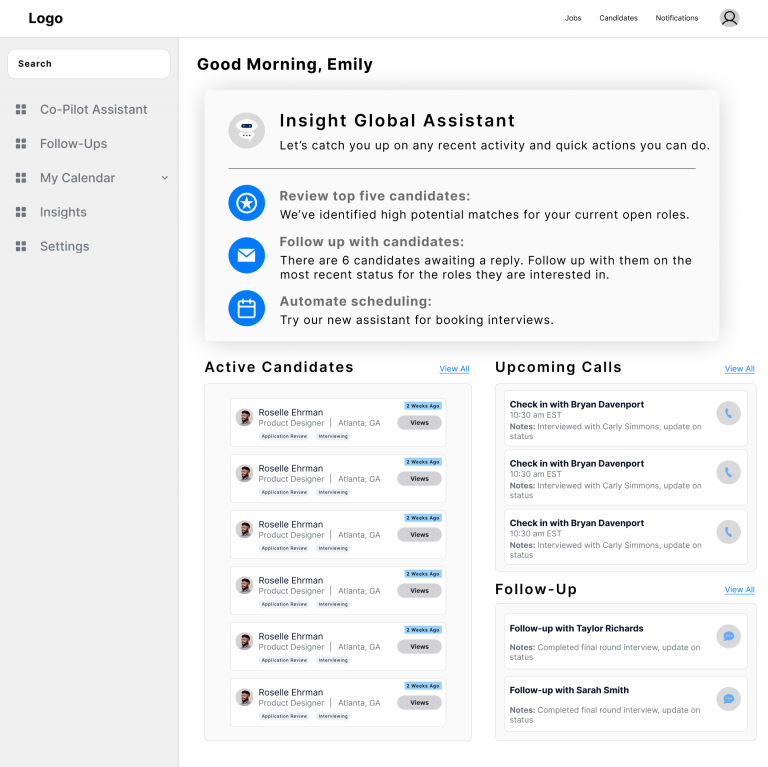
In response, I designed the Insight Global Assistant — an AI-supported recruiting workspace that centralizes job management, candidate insights, scheduling, and follow-ups into a single intelligent dashboard. The solution streamlines high-frequency tasks and helps recruiters move candidates through the hiring process faster and more effectively.
Final Prototype:


Approach and Design Process:
Navigating Ambiguity
This challenge was intentionally open-ended. There were no predefined users, constraints, or success metrics. Before designing, I had to define where meaningful impact could exist within the hiring ecosystem.
I chose to focus on recruiters as the primary user because they operate at the center of hiring momentum. Improving recruiter workflows creates downstream impact across candidates and clients. This decision established a clear direction and allowed me to scope the solution strategically.
Defining the Opportunity
I analyzed the recruiter-client workflow to identify friction that slows placement. Repetitive follow-ups, fragmented tools, manual scheduling, and unclear status tracking emerged as consistent pain points.
While these issues may seem small individually, they compound across multiple roles and candidates. The opportunity was not to redesign hiring entirely, but to reduce cognitive load and eliminate recurring micro-delays that slow momentum.
Concept Development
Based on these insights, I designed the Insight Global Assistant as a centralized recruiting workspace. Instead of building a separate product, I embedded intelligence directly into existing workflows.
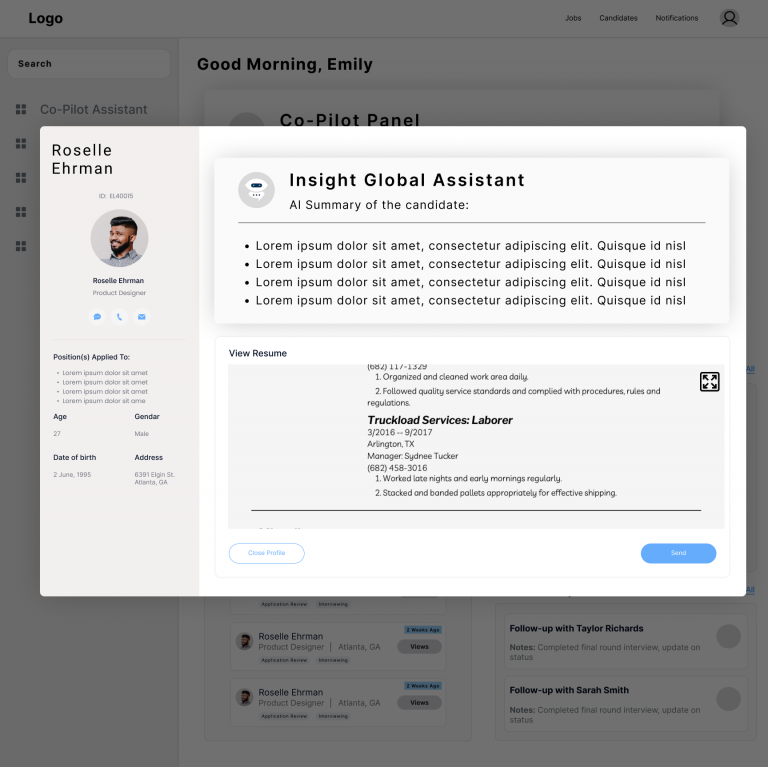
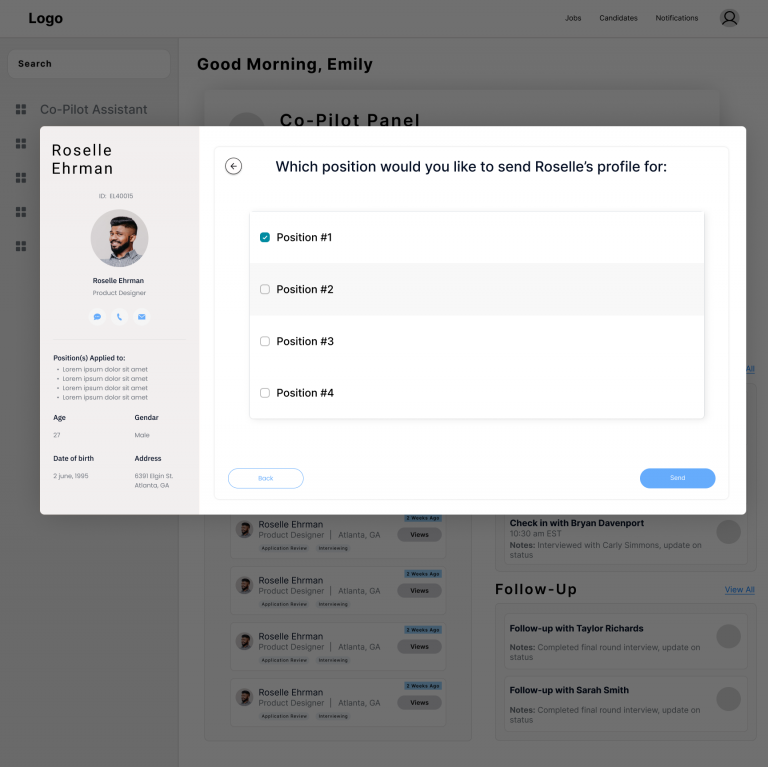
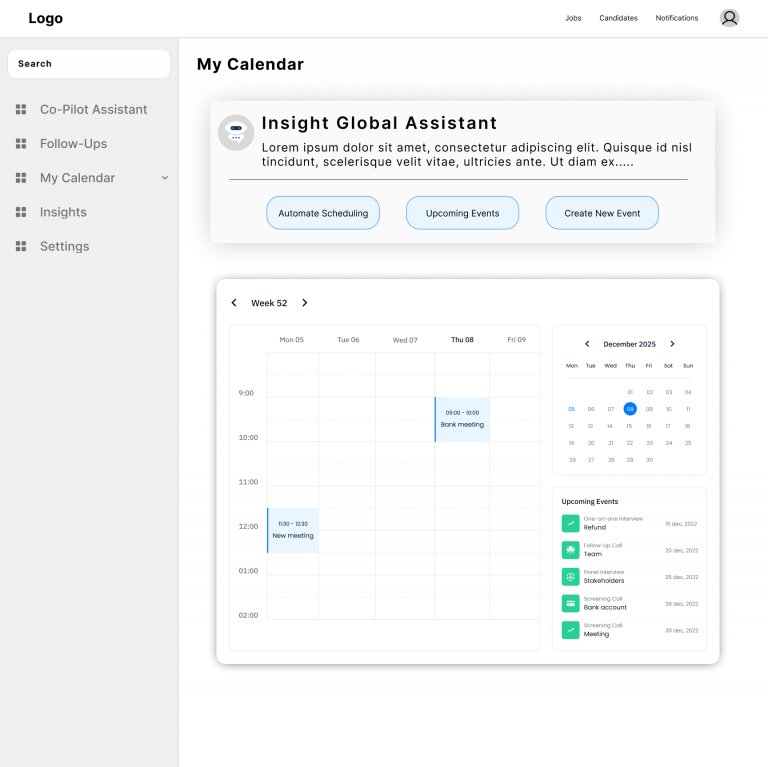
The solution surfaces high-priority candidates, generates AI-powered summaries, automates reminders, simplifies candidate-to-role submissions, and integrates scheduling into one unified dashboard. The goal was to enhance speed and clarity without adding complexity.
System Design & Execution
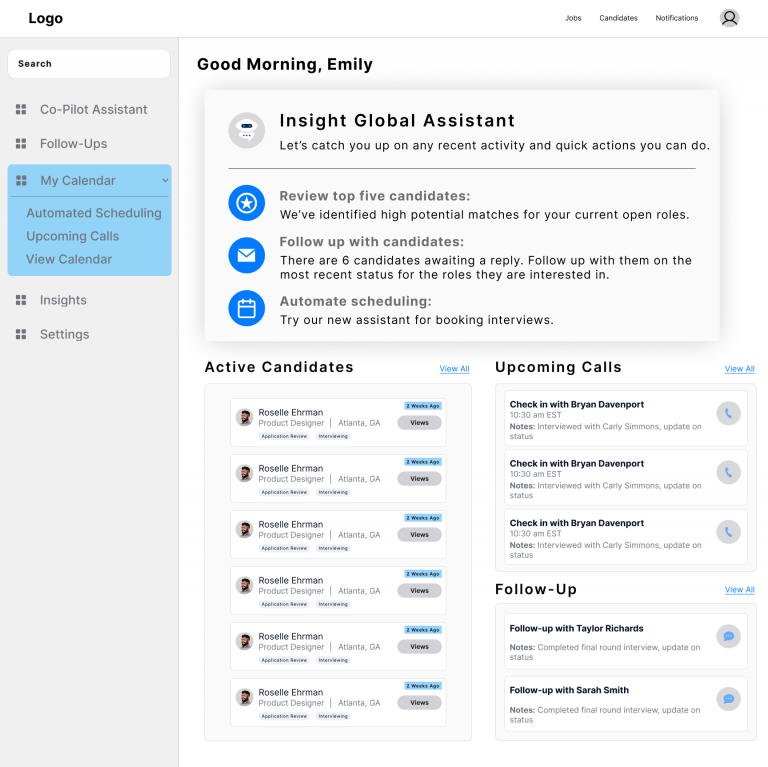
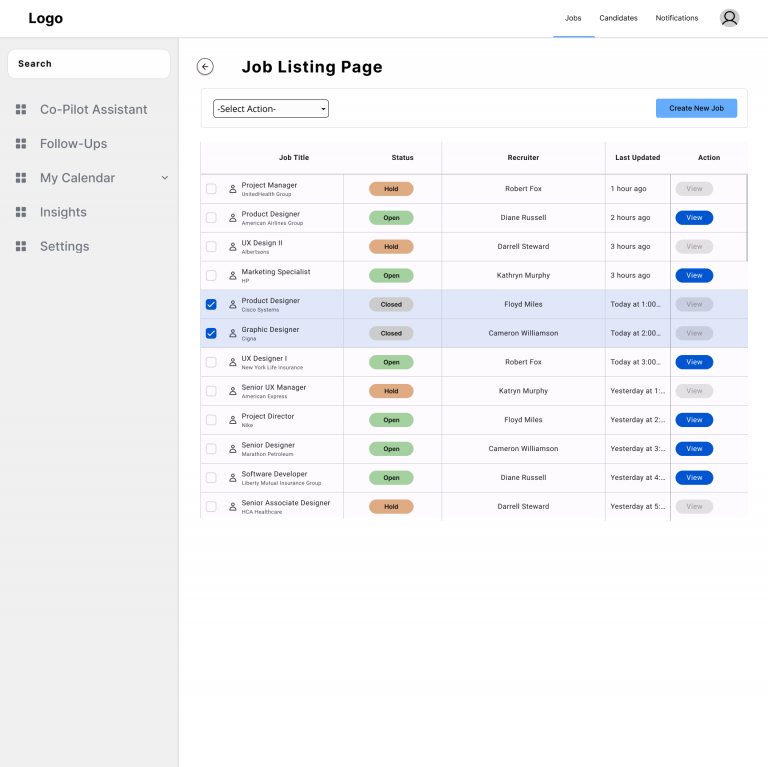
To demonstrate scalability, I designed across multiple touchpoints including the home dashboard, candidate profile, job listing page, and calendar view. This ensured the experience functioned as a connected system rather than isolated screens.
I introduced AI contextually and minimally, positioning it as a supportive layer rather than a dominant feature. Consistent navigation, modular components, and structured layouts reinforced usability while reflecting a product-ready system.
Final Solution & Impact
✅ Recruiter-Centered Problem Framing: Identified recruiters as the highest-leverage user group within the hiring ecosystem, focusing on workflow efficiency to accelerate overall placement outcomes.
✅ Centralized AI-Supported Workspace: Designed the Insight Global Assistant to unify job management, candidate insights, follow-ups, and scheduling into a single cohesive dashboard experience.
✅ Intelligent Candidate Acceleration: Introduced AI-powered resume summaries, top candidate surfacing, and quick candidate-to-role submission to reduce review time and decision friction.
✅ Operational Efficiency Enhancements: Streamlined follow-ups, automated reminders, job status visibility, and calendar coordination to minimize repetitive manual tasks.
✅ System-Level Design Thinking Under Ambiguity: Defined scope, assumptions, and scalable interaction patterns within an open-ended challenge, delivering a multi-touchpoint solution across dashboard, candidate profile, job listing, and calendar views.

Key Takeaways & Reflections
💡 What I Learned:
Defining the problem is often the most critical step in ambiguous challenges; strategic framing determines the quality of the solution.
High-impact innovation does not always require reinventing systems; reducing friction in frequent workflows can create meaningful operational gains.
AI is most effective when positioned as a supportive layer that reduces cognitive load rather than replacing human decision-making.
🚀 Next Steps:
Validate assumptions through recruiter interviews and workflow shadowing to test real-world pain points.
Prototype and usability test the dashboard and candidate profile experience to measure task completion speed and clarity.
Explore system integration opportunities to ensure the assistant complements existing ATS and recruiting tools without adding complexity.
Want to see the full presentation...
Click the button below to view the complete presentation deck. It outlines my full design process, including problem framing, opportunity definition, concept development, and final solution rationale.